Earlier today, I served as the “young woman’s voice” in a panel of local experts at a Girl Scouts speaking event. One question for the panel was something to the effect of, “Should parents read their daughter’s texts or monitor her online activity for bad language and inappropriate content?”
I was surprised when the first panelist answered the question as if it were about cyberbullying. The adult audience nodded sagely as she spoke about the importance of protecting children online.
I reached for the microphone next. I said, “As far as reading your child’s texts or logging into their social media profiles, I would say 99.9% of the time, do not do that.”
Looks of total shock answered me. I actually saw heads jerk back in surprise. Even some of my fellow panelists blinked.
Everyone stared as I explained that going behind a child’s back in such a way severs the bond of trust with the parent. When I said, “This is the most effective way to ensure that your child never tells you anything,” it was like I’d delivered a revelation.
It’s easy to talk about the disconnect between the old and the young, but I don’t think I’d ever been so slapped in the face by the reality of it. It was clear that for most of the parents I spoke to, the idea of such actions as a violation had never occurred to them at all.
It alarms me how quickly adults forget that children are people.
Apparently people are rediscovering this post somehow and I think that’s pretty cool! Having experienced similar violations of trust in my youth, this is an important issue to me, so I want to add my personal story:
Around age 13, I tried to express to my mother that I thought I might have clinical depression, and she snapped at me “not to joke about things like that.” I stopped telling my mother when I felt depressed.
Around age 15, I caught my mother reading my diary. She confessed that any time she saw me write in my diary, she would sneak into my room and read it, because I only wrote when I was upset. I stopped keeping a diary.
Around age 18, I had an emotional breakdown while on vacation because I didn’t want to go to college. I ended up seeing a therapist for – surprise surprise – depression.
Around age 21, I spoke on this panel with my mother in the audience, and afterwards I mentioned the diary incident to her with respect to this particular Q&A. Her eyes welled up, and she said, “You know I read those because I was worried you were depressed and going to hurt yourself, right?”
TL;DR: When you invade your child’s privacy, you communicate three things:
You do not respect their rights as an individual.
You do not trust them to navigate problems or seek help on their own.
You probably haven’t been listening to them.
Information about almost every issue that you think you have to snoop for can probably be obtained by communicating with and listening to your child.
Part of me is really excited to see that the original post got 200 notes because holy crap 200 notes, and part of me is really saddened that something so negative has resonated with so many people.
I love this post.
Too many parents wonder why their kids aren’t honest with them, and never realize their own non-receptive behavior and their failure to listen are the reasons why.
At one point or another, a child WILL keep a secret from you, but if it’s to a point where all their emotional feelings are being poured away from you as opposed to toward you, it’s probably because you haven’t been emotionally trustworthy or open.
Adultism 😦
not to mention, you then take away one of your child’s coping mechanisms. if your parents read your journal, you’re never writing in it again. if your parents monitor your conversations with friends, you won’t tell them when you’re depressed anymore. if you have a therapist that reports what you say to your parents, you won’t tell that therapist anything. now all those methods of venting, feeling better, self-soothing, sorting out your issues, and feeling safe are gone.
“i want information” is not synonymous with “i want my child to talk to me.” those are two separate goals, but i think parents conflate them – i want my child to talk to me, but since they won’t, i’m stealing information from them. no. you didn’t ever want them to talk to you. you wanted information. if you wanted them to talk to you, if that was your entire end goal, you would have approached things completely differently. stealing information from a child ensures they will never talk to you again. but if all you want is information, then you can take it however you want and call it a parenting success.
if what you wanted was a child who talks to you, you would apply the same principles you do to literally any other human interaction in your life, and cultivate a relationship and trust.
I had to stifle my horror and revulsion at my last job, when a conversation about removing the door from a child’s bedroom came up, and I was only one not in favor of it.
May be worth noting I was the only millennial in a conversation that was otherwise full of baby boomers.
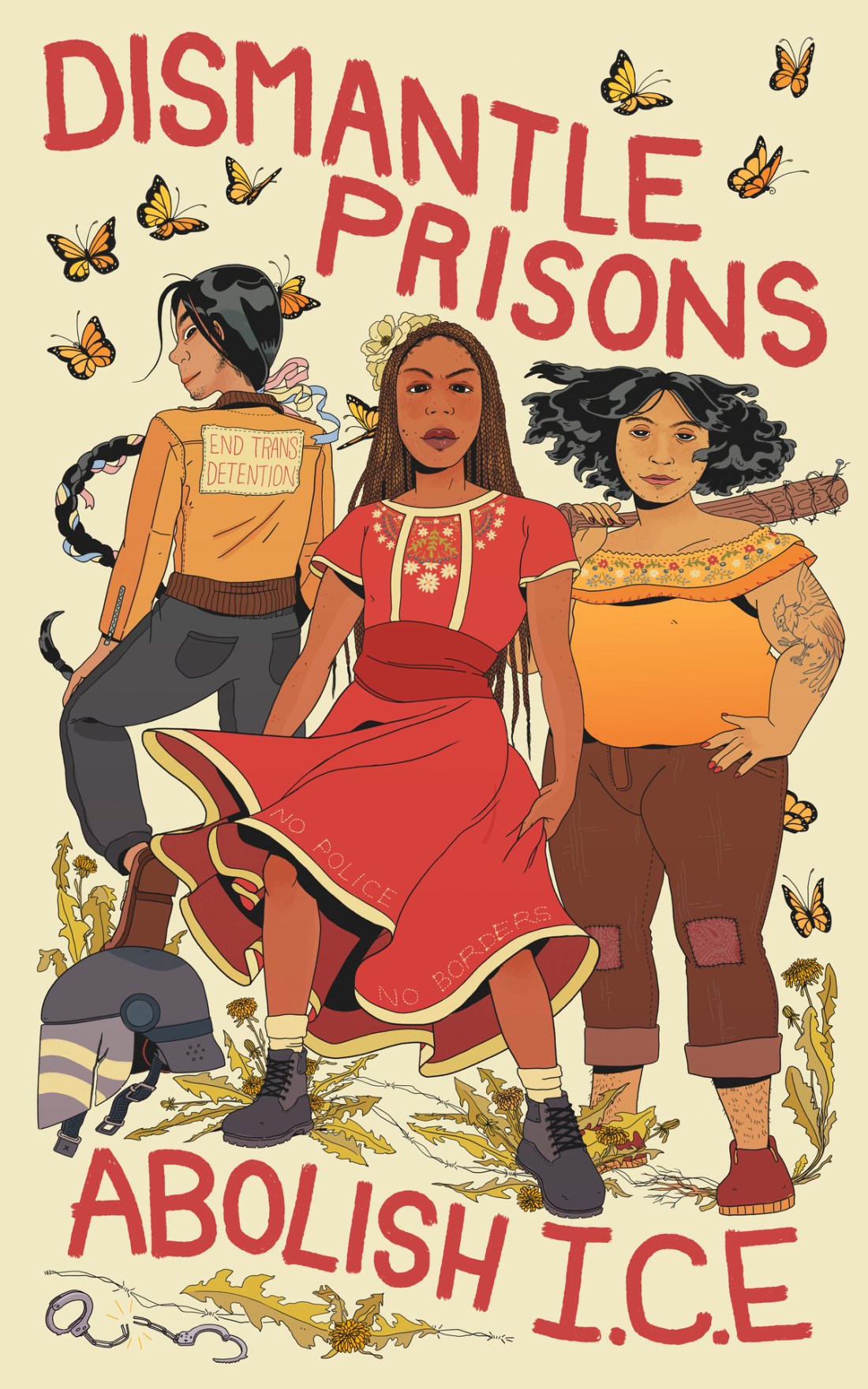
I’ve been incredibly blessed again to work with Forward Together in collaboration with Familia: Trans Queer Liberation Movement, Micah Bazant, and Jennicet Eva Gutiérrez for a Transgender Day of Resilience & Remembrance poster.
People of diverse genders and trans folks have always led movements for freedom. They are the first to struggle against the weeds of oppression and colonization, and the first to protect and free their communities. We dismantle oppressive systems from the ground up, for the good of all people. We stand together, unashamed in all our pride and glory.
Please check out the work of both organizations to learn more about how to contribute to the fight for liberation. Feel free to download the poster here and print it for your own use – https://sellfy.com/p/yGYk/
I don’t think you can talk about makeup politically without talking about economic oppression. Women are expected to spend thousands a year on cosmetics (and other stuff likeclothing, health supplements, etc) when men aren’t. This isn’t just because of social pressure, it’s required by employers implictly or explicitly the majority of the time. Women are expected to put in an extra hour, if not more, work every day for no compensation before they even leave the house. Class society props up everything else
This is Susan Robinson, one of the last people in the country who can preform late term abortions after the murder of Dr. George Tiller. This is from an awesome documentary called After Tiller, about the last 4 late-term abortion practitioners in the country.
This documentary is so so powerful and also available on Netflix! I highly recommend it
Nearly 99% of all abortions in the US occur before 21 weeks. Of those that happen late in pregnancy, many are due to complex circumstances, including severe fetal anomalies.
Stephen Hillenburg was a marine biologist who created Spongebob as a part of a project to help educate kids on the ocean while working at the orange county marine institute. many of the characters in this educational comic went on to become a part of the series, including the future cartoon’s titular character, then known as Bob the Sponge.
this cartoon revolutionized the industry and in its initial boom was widely adored for its ability to be enjoyed by all ages and all demographics, creating an animated juggernaut for its generation akin to the simpsons or looney tunes, with people of all stripes able to remember its finest moments at the drop of a hat.
hillenburg began his official work on this groundbreaking program 15 years after graduating college. he left his career at the marine institute to study at CalArts. he didnt get his MFA until the early 90s. spongebob squarepants, now considered by many to be nickelodeon’s premier nicktoon, began airing the year he turned 38. his adventure as a professional truly shows the power of pursuing far-flung dreams, and that someone can do something huge long after their supposed “prime.”
this man changed animation, nickelodeon, and the childhoods of millions of people around the world forever in his unfortunately short life. i think it should be known just how much he managed to do in his time here, though, and his work and lofty ambition was something to be admired.
the above clip, featuring tiny tim’s “Living in the Sunlight,” is from the debut episode, “Help Wanted,” partially written by Hillenburg. It perfectly encapsulates the completely unorthodox and wildly entertaining tone that made this show so great.












 ForLoveFromFear