You know what really pisses me off about that “it’s all in how you raise them” mindset though? It makes good owners feel like fucking shit.
I’ve owned Diego since he was four months. I did everything with him, socialized the hell out of him, he loved other dogs when he was young. We went to training classes, etc.
And then one day when he was about eight months old he jumped a dog. He no longer tolerated strange dogs.
And I felt like fucking hell. I believed that “it’s all how you raise them” shit. Here I am doing my best with this dog, and he turns out like this! I seriously considered rehoming him.
It took a lot for me to get out of that stupid mindset. I took him to behaviorists and trainers who all pretty much said the same thing – that’s his personality.
I don’t know where I’m going with this post. It just ticks me off.
This was my biggest downfall with Daedra. Daedra was aggressive from day one. He was a shit. I remember before he turned 2, I called up a local trainer, and I was pretty straightforward: “He tries to kill other dogs. Can we still be in a class?” She let us, and guess what. It was hard. People gave me looks. My aggressive dog wanted to take out dogs twice his size. We were given lots of space.
We went to class, it didn’t get better. I got help from other trainers. I did a lot of punishment based shit with him. I did stuff that hurt me – my dog lost trust in me, still wanted to kill other dogs. I didn’t know what to do, because clearly, somehow, I was fucking up because it is “how you raise them” and border collies are SO well known for being “dog friendly.” Clearly, the issue was me.
I stopped doing anything public with him. He was a time bomb, he had bitten me once when he was like.. four? I should have gotten stitches – I was SO certain he was going to be taken from me and put down, I didn’t go. Still have scars now. I couldn’t trust him, he didn’t trust me, so I stopped everything with him. My sport dog became just a pet, I turned to Vivec, and it stayed like that for a few years.
When he turned 6, I found out a trainer I had been following on Livejournal lived in the same town I had moved to. I went to her, one on ones, for two fucking years. Daedra got a bit better. I got better. I mentored under her. Still some aversives, but nothing harsh. I went to another trainer. We trained for agility. We competed.
He still wanted to kill other dogs. He just loved me more and I was hell of a lot more likely to be careful with him. I got to where I’d defend him, block off dogs, tell people to back off with their “friendly dogs.” My dog isn’t. Mine will try to kill your dog. Give us space.
And in the end, you know what I learned? It’s genetic. I talked to someone else that had a sibling of his and she had aggression issues as well – not to Dae’s extent, but her dog did. She knows someone else with a sibling.. same thing. While Dae is definitely an aggressive dog, there’s more going on with him than “just” aggression. It’s clear something is wrong in his head, but still – it isn’t “how he was raised,” it’s the fact I obtained a dog that just happened to be a lot on the aggressive side of the scale. It isn’t something I’d do again, as now in his old age, Daedra is a LOT to handle, but it just goes to prove sometimes dogs are aggressive and that’s okay.
I still can never understand how people can believe dogs can be bred to have herding instinct (which is modified prey drive) or be from hunting lines but not believe they can be bred to be aggressive.
I always think of this the other way around with Mango.
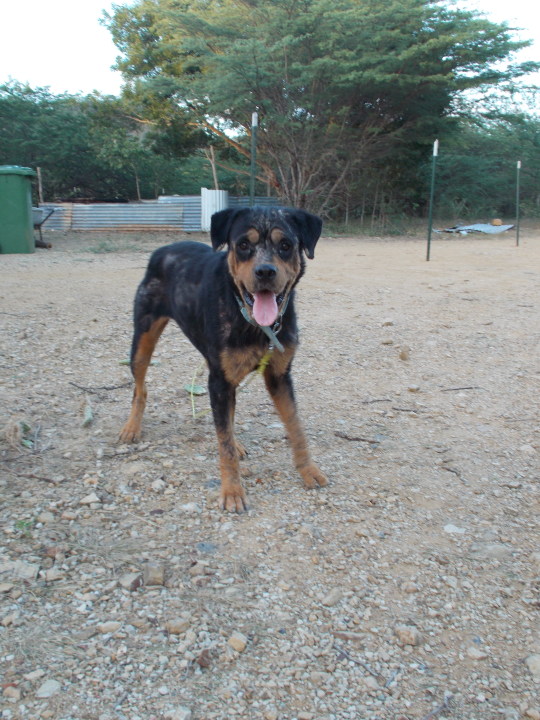
She’s a rottweiler, so a breed prone to being aggressive. And she was neglected as a pup, when I got her she was skinny, half bald with mange and jumpy if you moved to fast around her head. And she was the wriggliest, friendlisest pup you could ever imagine (if a little shy, which she still is). If it were all in how you raise them, she’d be a mess.
She’s been home about 3 days in this picture:
All she wants to do is play. She wasn’t raised well, I can’t take any credit for her there, it’s just her.
This.
*pulls out a large scattered pile of handwritten notes stuffed into various textbooks and notepads*
LET’S HAVE A TALK ABOUT SOME MOTHERFUCKING REACTION RANGES, KIDS.
A reaction range (or range of reaction) is the intersection of nature and nurture in terms of traits which are variable, complex, and (in some way) quantitative. Things like wariness and intellect are not ‘quantitative’ in the same way that jelly beans in a jar are but they are called so in this instance with the understanding that ‘qualitative’ means things like, spotted or drop earred. With quality you either are or your aren’t. With quantity there is a possibility to be more or less of a trait. (Please hold comments on how dogs can be more spotted or less spotted, etc… This is how these things are defined in this setting, just bear with me)
So, with this in mind, friendliness, or it’s converse, aggression, are both defined as quantitative traits. You can be more friendly or less friendly, more aggressive or less aggressive. It is a spectrum. In a simplified imagining of this you have one side which is an imaginary dog who never knew a stranger, absolutely loves everyone and everything and would never snap or growl under any circumstances, on the other sides is another, equally imaginary dog who is aggressive towards everything and everyone, knows no ally and never has accepted a kind hand in its life.
These are extremes. In the grey area in the middle lies every dog you have likely ever met in your whole life and every dog you are likely to meet ever. These are also specific. The spectrum for dog-agression is not the same as human-agression, not the same as prey-drive, and in real life is often separated between sexes and sizes and personalities of other dogs. (ie; same-sex-dog-aggression, larger-dog-aggression)
This is where the nature comes in. Each dog (and creature) is born with a set range of possible outcomes for these quantifiable traits, in this case dog-friendliness (we will ignore the narrower categories for now and try to put them in this simpler umbrella). If we set this spectra on a scale of 1-150, higher numbers being friendlier dogs, then a sample dog, must fall on this number scale.
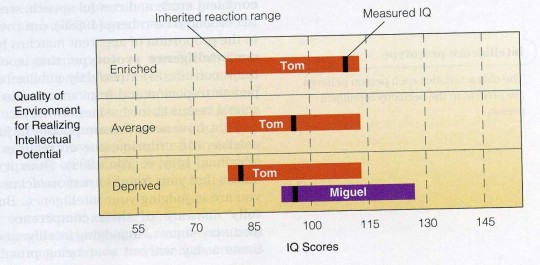
So, we have a litter of puppies and pick one at random, we name him Tom. Tom is a Shepherd mix who we know, though our all-powerful hypothetical powers) is born with a reaction range from about 80-111. As he matures Tom can land anywhere on this spectrum of friendliness from 80-111.
This is where nurture comes in. If we clone Tom twice and give Tom1 to a deprived home with no training and almost no socialization and that will abuse him, Tom2 to an average home that is well-meaning and offers some training and socialization and treats him pretty well otherwise, and then we give Tom3 to an enriched home, a dog expert who trains him well, socializes him from the first day, and loves on him as often is appropriate, each Tom will grow up to fall on different parts of the reaction range. Tom1 ends up on the lower end of the spectrum, around 83, Tom2 is mid-range, around 92, and Tom3 is on the high end of the spectrum, around 108. The more enriched environments give the best possible outcomes.
Now we introduce another dog, Miguel, a hearty little Lab mix who was recently rescued from an abusive home. We know that Miguel has a friendliness range from 97-125, higher than Tom. So, we compare him to the three Toms. (pretend this is friendliness not IQ)
Miguel is more friendly than the equally deprived Tom, and just as friendly as the average Tom, despite having a poorer quality of life. If given to a home which is patient with him, Miguel may have a chance of rising higher on his scale and, one day, may be even friendlier than the enriched Tom.
But, you may ask, can Tom ever be as friendly as an enriched Miguel that is at the tom of his reaction range? No. The absolute answer is no. Each dog is born with their own innate range, woven into their very core by the wonders of genetics. You can make a dog as high on it’s range as it can go- but it can never go higher. Tom will never be able to be as friendly as Miguel, but the Tom raised in the enriched home will be much friendlier than the Miguel who was raised by the deprived home and received no help, too little help, or help too late.
How does this influence how we look at our own dogs?
The reaction range warns us to all heed the over-arching themes within each breed type– they exist for a reason. Chows were bred to guard and will be more wary of strangers, Hounds were bred to track and will follow their noses, and fighting breeds were bred to be dog aggressive and will be more likely to not get along well with others. You may have the most dog friendly, well bred and trained Cane Corso in the world, but realize that it will never be as friendly and amiable as most any decently bred Golden raised to it’s full potential, and getting it there will involve your hard work and diligence.
But it sets that breed is not always destiny. The lines a dog comes from are important too and there are poorly bred Lab can be born with a lower than expected reaction range & visa versa. Other times neurological issues, hormone imbalances, or psychopathology, along with other possible issues do play a role.
It also encourages us to train the dog that we have- not the dog we wish we had. If you have an aggressive and reactive dog but wish to play flyball… you are going to have to think realistically. If you can’t even walk on the opposite side of the street as another dog without having to pull all the stops to keep your dog under the control of it’s training (leave it!! watch me! watch me! good boy! sit. good boy! watch me!) and keep it from snarling and lunging- then congrats, you have taken your reactive dog and made the best of it’s genetics by bringing it to the top of it’s reaction range. BUT you would be making a mistake to try and get this dog to do more than it can, or at least to try after getting strong feedback that it would be unfruitful to try again.
It does not make you a failure of a owner or trainer that your dog can not do the things that the dogs of others can. Read that again.
It does not make you a failure of a owner or trainer that your dog can not do the things that the dogs of others can. If anything it makes you a wonderful owner and trainer to recognize what your dog is capable of and strive to bring it to the best of it’s ability without pushing it to an impossible goal.
So, do your research when choosing a breed, talk to the shelter or breeder extensively, gauge what your dog is capable of, and accept the roof of possibility when you hit it. Every dog is unique. Your dog is your dog and no one else’s- all you are expected to do is make it the best dog it can be with the genetic code it was born with.
Your dog is special, remember that. *closes notes*

 ForLoveFromFear